


Things that I did in my classroom the week after winter break...
Sprinkled in a few New Year's Activities:
- One Word
Students create a Google Slide with a word that describes their year, goals, etc.
Students think ahead to 2026 and the things they would like to accomplish.
Students use Google Slides or Canva to create a vision board for the upcoming year.
I assigned this slide deck in Google Classroom for students to complete during the first week back. It gave them a safe place to let me know how their break was and how they are currently feeling about being back at school. You will be surprised what they will tell you!
Most things stayed the same, but I took this opportunity to change a few things for the second half of the school year and review the routines that were the most important to our classroom.
I also introduce a one rule classroom at this point in the year. It's simple and something that I can use to easily redirect as needed. Is what you are doing interrupting the learning of others? Then don't do it.
This year I decided to redo my classroom library organization. Books are organized by genre or by series, so I created genre posters to help kids learn about the different types of books. New organization means new resources to share!
My classroom library has been my pride and joy since I first started teaching. Facebook Marketplace, yard sales, and McKay's Used Book store are great places to look to get used books. If you work in a title 1 school you can also sign up for First Book Marketplace to get new books for really great prices.
I can be a little Type A, so I also use an app called Book Buddy to keep track of my books. You can easily add books to the inventory by scanning the barcode on the back of the book or doing a search online. You can set it up to have students check out books from your classroom library, but I use it more often to see if I have a book that a student wants to read. Unfortunately, the app is only available on Apple products and it does cost a one-time fee of $4.99, but compared to the free versions it was worth it in my opinion.
I created the book bin labels to match the genre posters below. I like to organize my classroom library by genre or content area. The chapter books will each have a bin for the genre, unless I have enough of a book series to create their own bin. The picture books are organized by content area (ie. math, social studies). Click the link above to download your own copy of the labels.
I created these posters as a fun way to learn about the different genres. I wanted them to look like movie posters and Canva made that possible! Click the link above to download your own copy of the posters.
January is the time that many teachers do a reset. After students have been away for a week or two, it is always important to review the expectations of the classroom.
However, I also use this time to reset my classroom space as well. We are almost halfway done with the school year and I have gotten to know my students better as learners. Honestly, I like to change my space around throughout the entire year, but this is the time that I reflect and think about what my learners truly need on the walls, what learning spaces they need, and what materials they need.
I rearranged my tables and desks to give students options for learning spaces. I have two exercise balls and I have stools that students can use if they want a break from their chairs. I also allow them to sit on the carpet whenever they would like. I am wanting to move towards flexible seating in the entire room, but due to the amount of money this involves, I am slowly working on getting the needed furniture for that.
I also redid my wall space. Being in a new grade level means that it takes time to create the resources that I typically use in my classroom. Things like anchor charts, vocabulary cards, etc. When you teach the same grade level for 9 years, you accumulate items that you can reuse over and over. Luckily, moving from 5th to 4th has allowed me to reuse some items.
One thing I have been working on is redoing my math vocabulary cards that I hang on the wall as we learn about a new topic. I finally decided to sit down and update my math vocabulary for the year. All of my vocabulary cards have the vocabulary word, a definition, an image, and sometimes an example.
I created these FOREVER ago, but haven't used them since the pandemic. However I decided to bring them back and give them a face lift and share them with you all!
These random grouping cards allow you to create random groups in your classroom in a fun way that gets students up out of their seats. I enjoy using these because it eliminates the groups of friends that join together when you ask students to pick their own partners or groups. I don't like that there are always a few students who are left out because they are new or do not have friends in the classroom.
The first few times you use them it can take longer than expected for students to figure out the groups. I often start using them during the first week of school so students are comfortable using them after a month or so. Just as an FYI, I do not use these every time I group students together. As mentioned, it can be time consuming and let's be honest, sometimes I want to create specific groups.
The version that I use with my upper elementary students has multiple grouping options on one card. I like that I only have to keep up with one set of cards.
I am officially a month into teaching in North Carolina and experiencing standards-based grading and I am 100% sold that this is the best method of grading especially at the elementary level.
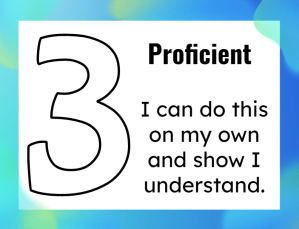
For those unfamiliar with standards-based grading, students receive a 1-4 for each standard taught during a quarter based off of their proficiency with each standard instead of a quarterly grade being determined by averaging a group of assignments on a 0-100 scale. Students might receive a 3 on two math standards and a 2 on another standard. This more focused approach shows the exact area of weakness, whereas a student could receive assignments of: 100, 75, 90, 50 and earn a C. Two of the assignments were an A so is it truly showing their academic ability when they had one assignment that they struggled on?
With standards-based grading the focus is on the learning and not the grade. Students understand that their goal is to show mastery of the standard by the end of the year, so if they don't understand something at first they still have time to show that mastery by the end of the school year.
It also means that if they don't understand something right away, instead of getting a 50% or lower on an assessment and then struggling to dig themselves out of that hole for the rest of the quarter, they can prove that they have mastered a standard and receive a 3 on it.
I find that I am not grading every little thing that we do together. At my previous county I was required to put in 2 grades per week for each content area. This is exhausting and completely puts the focus on the grade and not the content being learned.
So much of learning is doing things together. Why should I be required to grade something that we did as a class? I've taught my students to not worry about if something is graded, but instead just focus on learning how to complete the task at hand so that when something is truly graded they will be comfortable doing it.
The easiest way to organize standards-based grading is by having students create a portfolio of their learning throughout the year. In my classroom students have a binder with dividers for each content area where they keep their assessments and any other completed work that shows their mastery.
I've also created these signs for my classroom so that the students understand the meaning behind each level. It is a visual reminder that allows them to also rate themselves on each topic. They can read the descriptions and decide where they think they fall on a certain topic
I wish there was a way to continue this idea of standards-based grading throughout the rest of the grades 8-12 (unless it is already out there and I just haven't seen it yet). I remember being in middle and high school and there being so much pressure to get good grades that somethings I wasn't always focused on what I was actually learning.Thanks for going on my standards-based grading rant with me! I hope that we can continue to shift from a focus on grades to a focus on learning.
It's about that time. I have hit that point in my summer break where I am ready to start looking ahead to next school year. I will say that it is hitting a little later this year than normal, which is absolutely needed after this past year.
I revamped these I CAN statements to use in my room in place of putting up the standards. I like the direct statement that the students can read and say, "I can" do this!
I tried to make them appealing to the eye by adding a visual of some sort to help them understand what is expected. I also used bold and underline formatting to help identify key words in the statement.
These are all mostly in black and white, because let's be honest, who has access to a color printer at their school (*rolls eyes*). However, I do like to use colorful paper to print them on and make them pop in the classroom.
Click on the images below to get your FREE copy!
The second part of The Daily Five is the Cafe. This is a set of strategies that are broken into the four components of reading. (To learn more about them, check out www.thedailycafe.com/cafe)
For my Cafe board I decided to make strips that have the strategies listed on them and then once we have gone over one of the strategies we add it to the Cafe board. Also, I use the mini-Post-It note pads and have one for each student and put their sticky note under the exact strategy they are working on rather than at the top of each column.
Here is the Cafe board in my classroom:
I have used a version of these school supplies in my classroom, but wanted to recreate them based on the needs of the different teachers since some of us are teaching virtually, some are doing a hybrid setup, and some are back in the classroom full time.
This Google Slides presentation has school supply icons so that you can easily let students know which supplies are needed to complete an activity.
I have included 3 sets. The first set is the smaller icons that can easily be copy and pasted into a digital platform. This could be putting them at the top of an assignment, posting them in Google Classroom, or putting them on a slide that can be projected virtually or in a classroom.

The second set is the icon placed in a circle with the icon name. This is more ideal for the classroom. They can easily be printed on regular computer paper or card stock and laminated to be displayed in a classroom when students need materials for an activity.
The third set is similar to the second set, but it does not contain the circle or words, it is just a larger version of the icon that can be printed and cut out in the shape of the icon. I would print on card stock or computer paper and laminate for durability.
If you want to be able to edit this presentation to fit the needs of your classroom (ie. adjust sizes, change font, add different icons, etc.), then click on File, then Make a copy to get your own copy that you have editing rights to.

https://bit.ly/AmberPotterWebsite
Instagram: @mrspotterstyle
Twitter: @apotter730